

Anthropic’s new Claude for Teachers release lands in a very familiar K-12 teacher moment: summer planning, thin time, too much data, too many disconnected platforms, and a profession that is being told, once again, that technology is here to make the impossible stuff possible.
For context, I've used the first version of Claude since 2023.I still remember one of my students, Elias—now in medical school—telling me, “Hey, Professor, you should check out this new AI model.” He knew we had already been using ChatGPT in class since 2022 and comparing its limits with Gemini, then called Bard.
Since then, I’ve compared all three models extensively in my classrooms and faculty workshops. At first, Claude was the model you turned to when you needed a larger context window for text. Whenever I could afford it, I upgraded to the paid versions of ChatGPT and later Claude—with some help from the teachers’ union, AFT —and I have continued to write openly about each model’s strengths and weaknesses.
Along the way, I was surprised to meet a handful of people at one of these companies who actually cared about education.One person, in particular, changed my view of one company for the better.
I’m still going to remain skeptical. This will not be a shill piece or a hit piece. It is a practitioner’s first look at what is actually happening, what Claude for Teachers gets right, what it misses, and how the field could do better
This is going to be a two-part story. In Part 1, I’m looking at Claude for Teachers as a workflow: what Anthropic is showing in the demos, what may actually save teachers time, and where the model moves too quickly from student data to instructional decisions. In Part 2, I’ll look at the public rubrics, the github and evaluation framework, moving past whether Claude can produce teacher materials, and what kind of teaching Anthropic is teaching the model to recognize as “good”. I will also include my advice for Anthropic to do next.
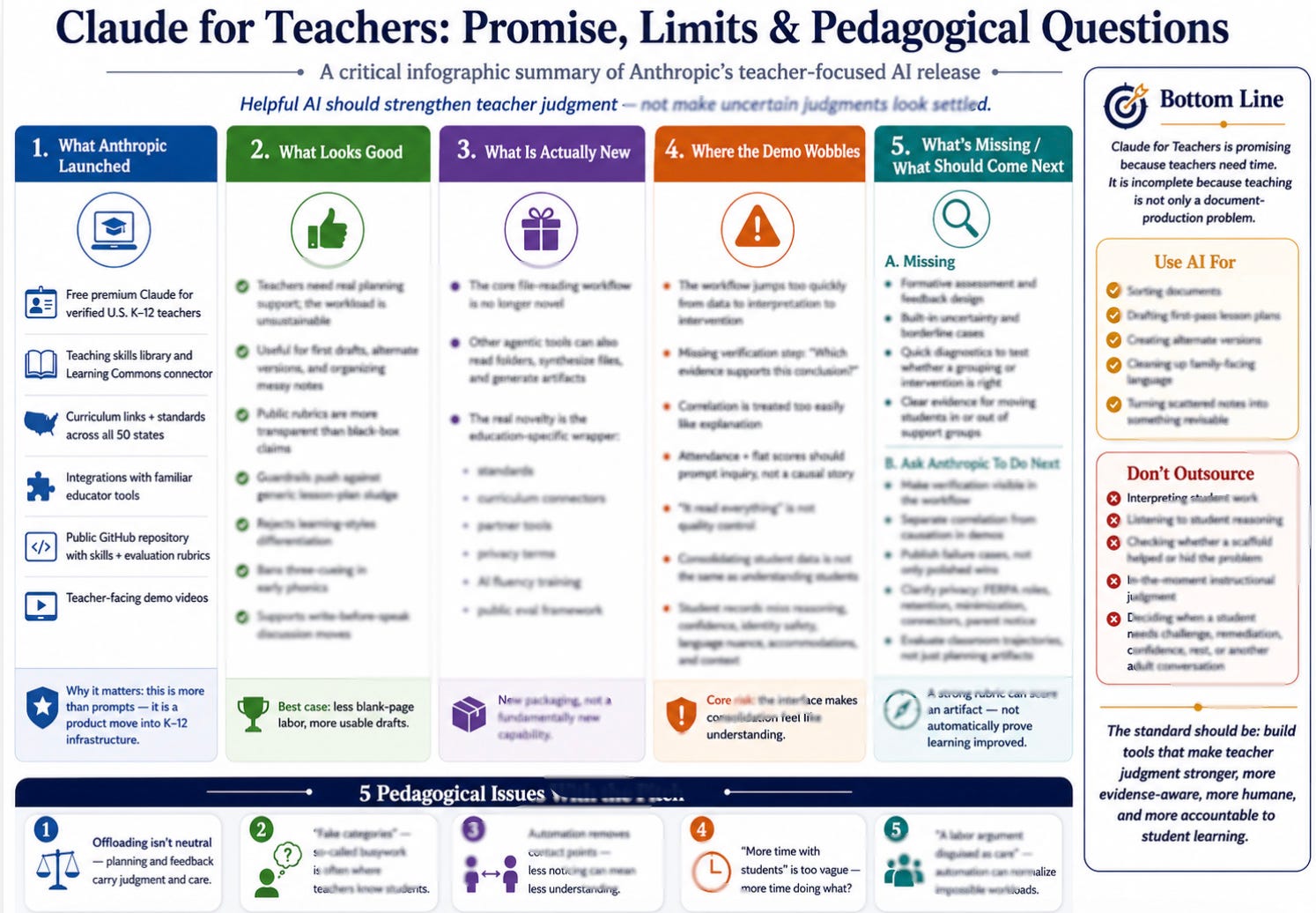
Anthropic says verified U.S. K-12 teachers can get free access to premium Claude — and free products have a way of becoming expensive habits once a school's whole workflow is built around one vendor.
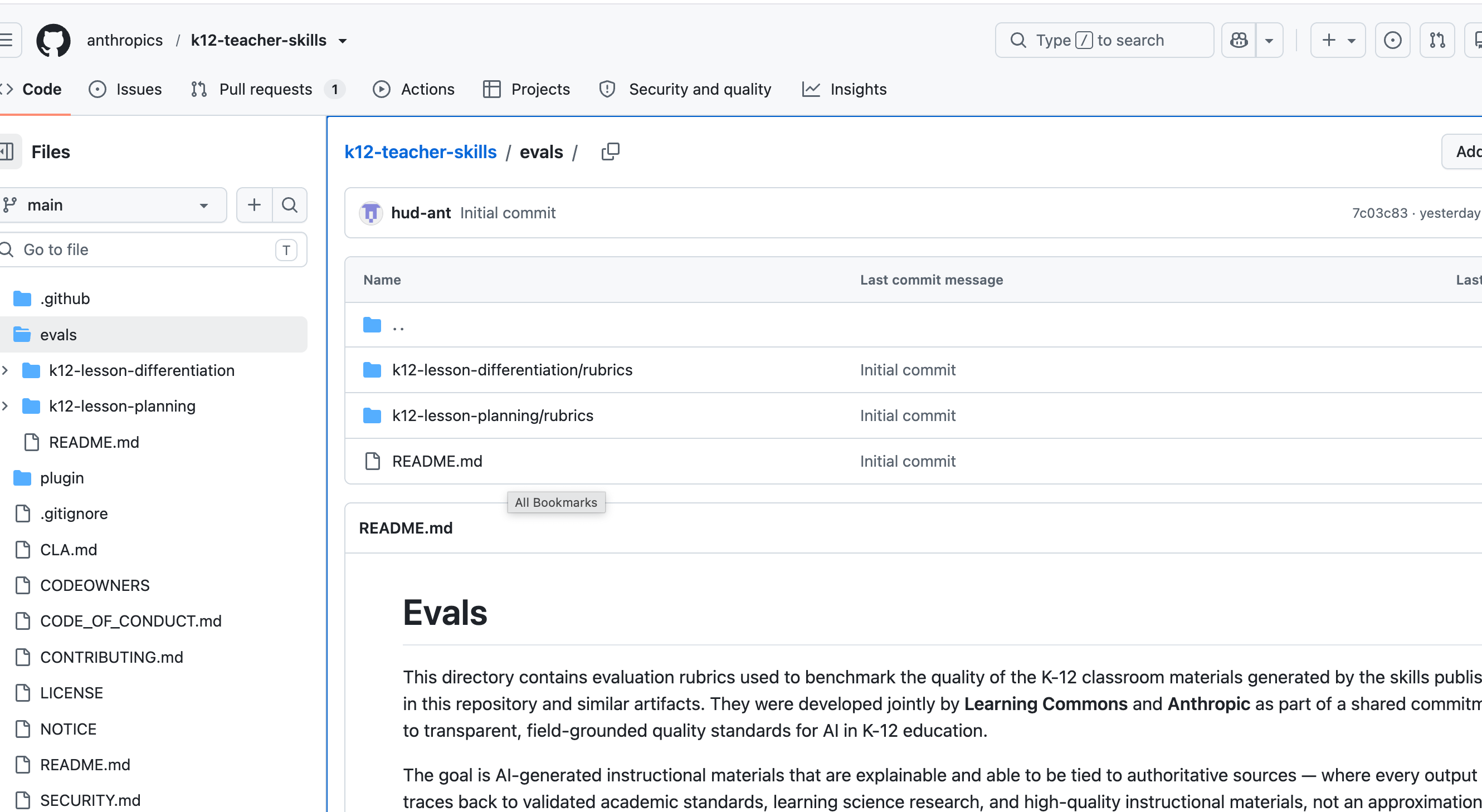
Anthropic has also released a public GitHub repository with the teacher skills and evaluation rubrics, along with two teacher-facing videos showing classroom use cases. I've had a chance to quickly look at it.
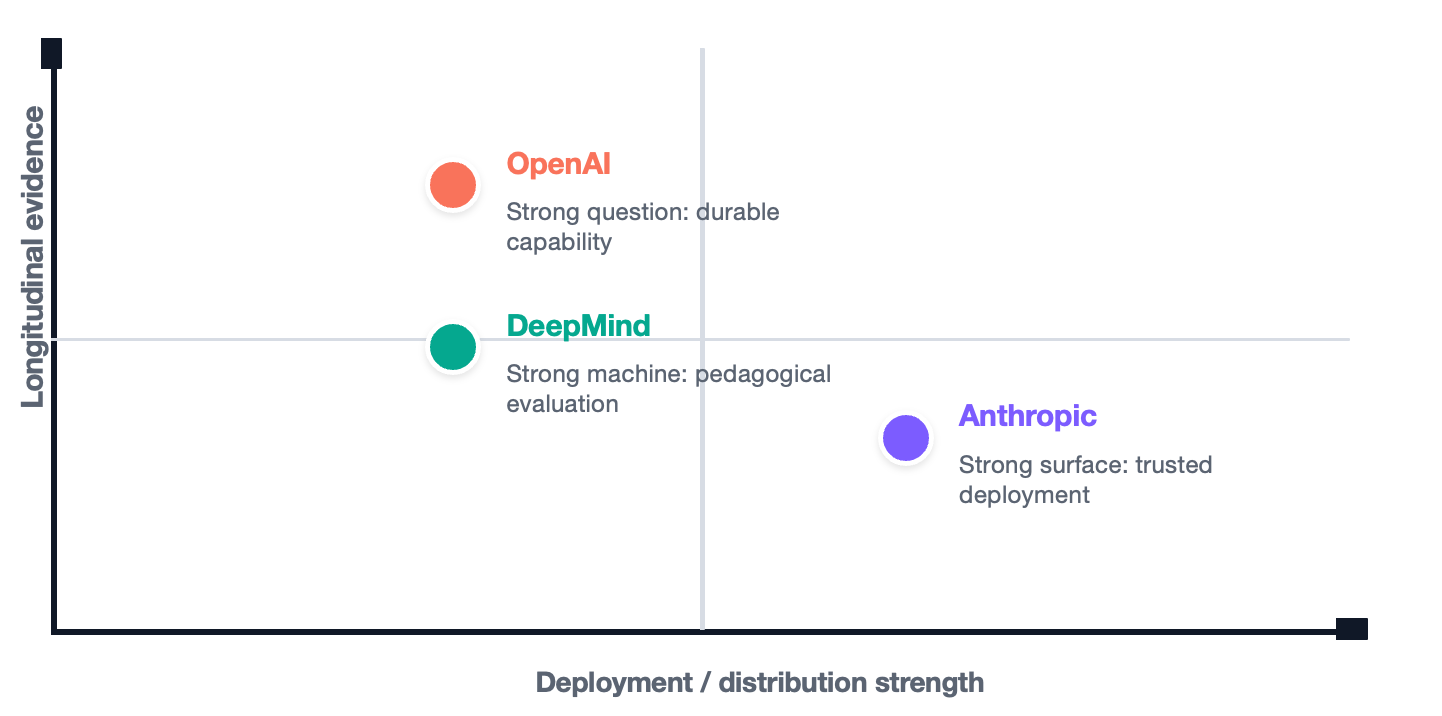
I've also been actively comparing the different pedagogical approaches frontier labs have been taking to improve learning. Here's a graph I put together (built with Codex) based on my own interpretation of what I could find publicly — for all I know, there may be different discussions happening behind the scenes that I'm not privy to.
Anthropic also released a number of teacher videos (see below), and I want to break each one down: where I see value, where it's just repetition of what's already possible, and where it might actually save time.
So the fair response is not eye rolling. Some teachers do need help. And having free Claude for an overworked teacher might be great. Lesson planning takes time. Differentiation is cognitively demanding work. If Claude can make the first draft less painful, I guess thats not bad.
But the demos and public rubrics still blur a line: organizing instructional data and understanding students are two different things.
Some of what Anthropic is showing isn’t unique to their agents. Sure, Claude can read files, synthesize notes, draft plans, make leveled materials, and organize outputs — but Codex can do much of that same file-grounded work: read a folder, revise documents, and carry a task through multiple steps.
In my USC grad school classes last year (before Claude Code and Atlas), I had my students build agents from scratch with n8n,
Here is an example of a teachers workflow we built with n8n two years ago which I presented at ASU+GSV spring of 2025:
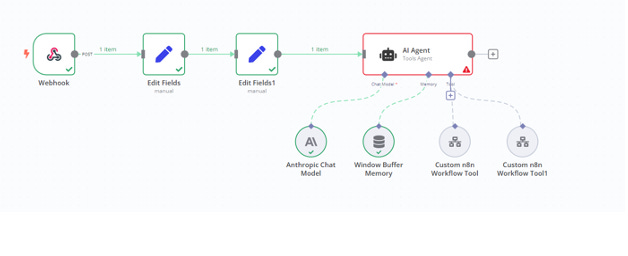
it handled many of the same basic tasks Anthropic is now demonstrating.
In fact, everything described in the video below, I was already able to do with Codex in my March Texas workshops (I wrote about it on LinkedIn). We used voice-to-text in the interactive classroom, and Codex was able to tell me in real time when I hit the high points, when the adult students lit up, where they struggled, and where I should focus next time. It prevented me from staying up until after hours to prepare my custom workshop for the next day.
Even back in the good old days of 2023, my first AI use case was figuring out which students I needed to reach out to first as the lessons got harder ( though I never gave the AI their names). Everything was anonymized.
But I was an early adopter and not everyone had the time to do these experiments.
The capability was already there; what was missing was a teacher-facing workflow that made it accessible and repeatable.
OpenAI launched ChatGPT for Teachers last November, with free access for verified U.S. teachers running through 2028.
Google has been building Gemini directly into its education products, and Microsoft is backing teacher training through its Elevate initiative. Free access for teachers isn't a differentiator anymore, but more like the entry price for any company that wants to be part of school life
