
The IKEA Effect & process based learning ..Why Students Stop Caring When AI Does the Thinking
At a recent keynote, we talked about the psychological relationship between effort and happiness and what AI-era learning should never give away too cheaply.

Many AI discussions focus on plagiarism or academic integrity. But the bigger risk may be motivational.
When we’re tempted to hand off challenging tasks to an AI tool… that means we’re doing less of the challenging stuff ourselves. And oddly, that means we’re doing our happiness a bit of a disservice
If students never experience the satisfaction of building understanding themselves, learning becomes something done to them rather than something they create.
As AI tools became more capable in 2024, I started noticing how students approached problems. I began wondering whether students were missing something more fundamental: the experience of building knowledge themselves.
There is a moment, somewhere between tightening the final bolt and stepping back to admire a newly assembled bookshelf, when something clicks. The object in front of you may be objectively unremarkable, or a little wobbly, perhaps. But it feels different. You think it’s better just because you put the work into building it.
And because you built it, you care about it.
Researchers Michael Norton, Daniel Mochon, and Dan Ariely documented this phenomenon in 2012 and gave it a name: the IKEA Effect.
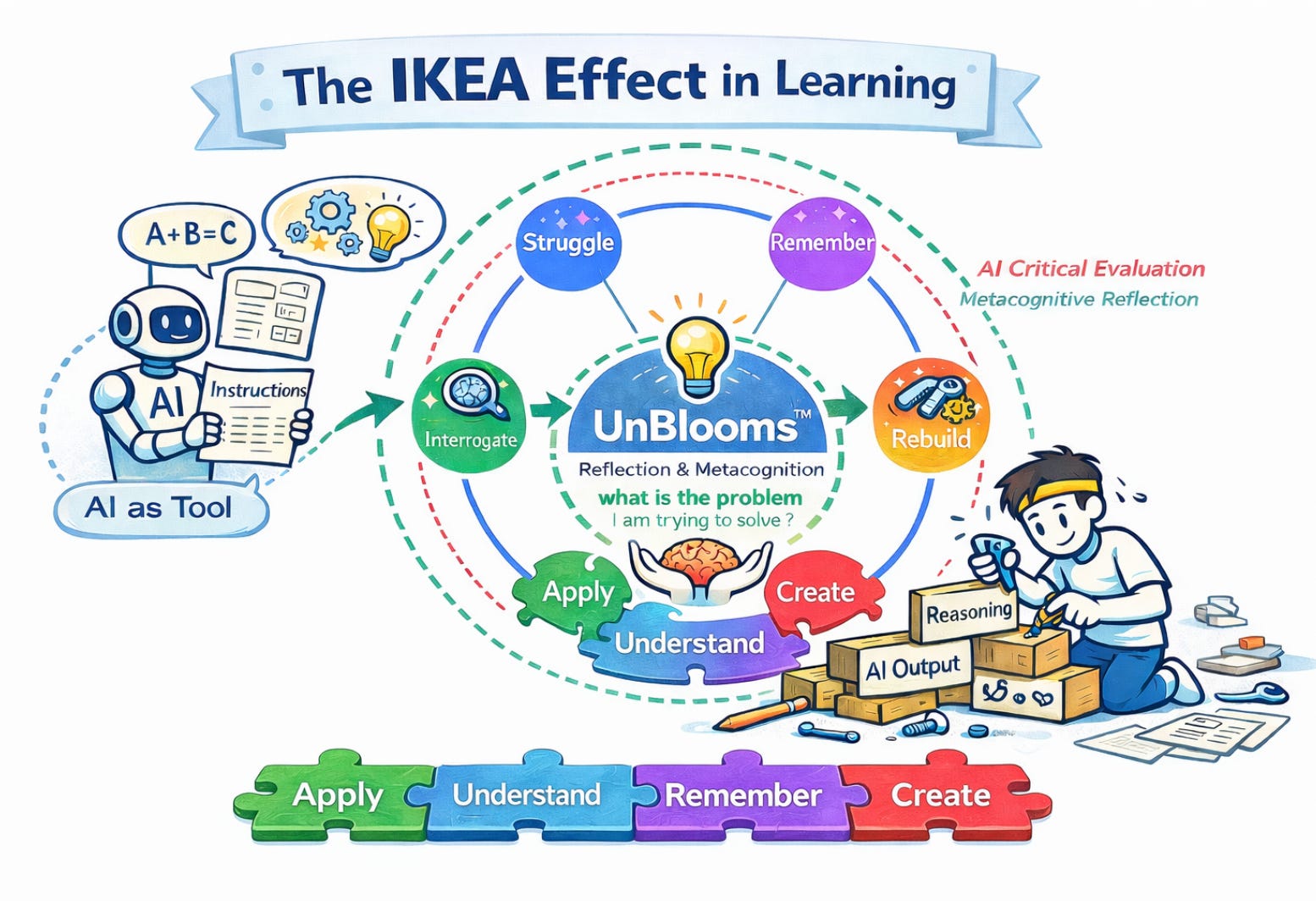
When I first encountered their work, I started thinking about learning environments. What might this mean for classrooms? And what might it mean for learning in a world where AI can generate answers almost instantly?
Those questions became harder to ignore once AI tools began appearing everywhere students worked.
Now consider what this means for learning. And then consider what AI, used carelessly, might quietly be taking away.
Participants who assembled IKEA boxes valued them more than ready-made equivalents.
The effort( not the quality) drove the perceived value.
Crucially, the effect depended on completion. Effort that ended in failure produced no special attachment. The emotional reward required seeing the task through.
Which raises a pointed question for educators: what happens to learning when students get the answer before they ever feel the productive friction of not knowing it?
What was interesting for me was finding out even animals are healthier when they work for rewards. At first look, this seems illogical. Why would any animal choose a path of work and effort rather than a path of freebies?

Animals (and humans) often experience a dopamine spike when an opportunity appears, not when the reward is received. The anticipation of finding food activates motivation systems.. And this means seeking or solving the problem can feel better than simply getting the reward.
Productive Struggle: The Educational Cousin
Educators have long understood something adjacent to the IKEA Effect, even without that name. They call it productive struggle.
As I started thinking about the relationship between effort, ownership, and learning, I began sketching a design question for my own classes:
What would a framework look like that keeps the problem (not the answer) at the center of learning?
That question eventually led to what I now call UnBlooms.
Bloom's Taxonomy assumes learning is a staircase (memorize first, create later) . AI broke that staircase entirely, because students can now "create" polished outputs at every level without doing any of the underlying thinking.) It is a recursive, problem-centered framework for learning design in the age of AI. The core idea is basically instead of a cognitive staircase you climb, UnBlooms is a loop you enter wherever the problem demands, with metacognitive reflection not as a final step but as a constant anchor throughout, it replaces the staircase with a loop. Instead of climbing levels, students cycle through four moves — questioning, generating, critiquing, refining — and can enter anywhere, depending on the problem
When students struggle productively, something is happening neurologically and emotionally that frictionless instruction does not trigger.
Curiosity is activated. Attention sharpens. Memory consolidation improves.
Experiential learning is often described as “learning by doing.” But the real learning happens after the doing — during reflection.
And reflection, in this context, means something very specific.
Recent research on AI in education (March 2026) is beginning warn that unstructured use of large language models can lead to cognitive offloading—students outsourcing the mental effort required for reasoning. Researchers increasingly argue that effective AI integration must deliberately preserve cognitive friction and sequence AI use after independent thinking rather than before it.
This is the learning version of the IKEA Effect:
Enter the reflection scale: Where the Problem Lives in the Center
My framework (published in 2025) was developed as a response to this challenge.
Instead of organizing learning around a fixed hierarchy of cognitive steps — remember, understand, apply, analyze — it asks educators and students to begin with a different question entirely:
What problem are we actually trying to solve?
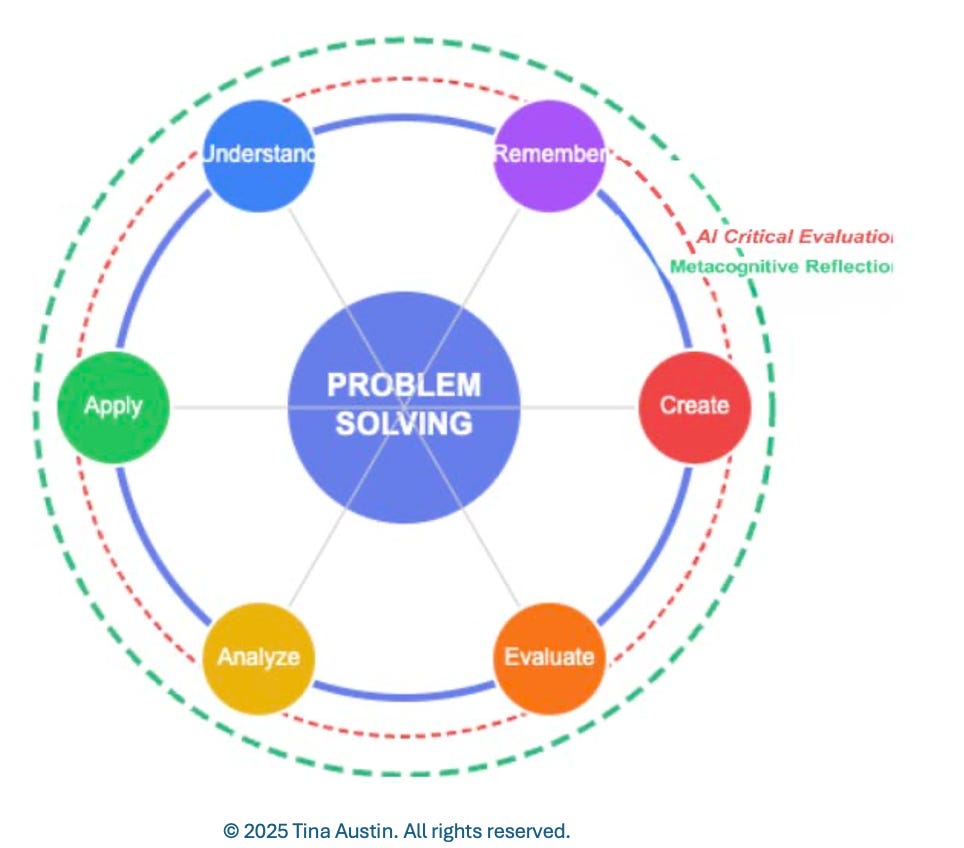
When the problem lives at the center of learning design, students cannot be passive receivers. They must interpret the problem, choose strategies, test approaches, evaluate outcomes, and revise. The thinking is not scaffolded into neat steps. It is recursive — students move back and forth between questioning, generating, critiquing, and reflecting, depending on what the problem demands. But the loop is not infinite, it must be a spiral to show improvement.
This is where the IKEA Effect becomes directly relevant. When students are working through a real problem (not retrieving a cached answer but genuinely building toward a solution ) they are doing the cognitive labor that generates ownership. The thinking they develop belongs to them in a way that copied or generated answers simply do not.
Unblooms asks this as a learning-design question.
It asks: what is the intellectual task, tension, uncertainty, or challenge that should stay at the center of the learner’s thinking?
But this is also an interaction/use question.
It also asks: what do you want the AI to do right now, and what outcome should it produce?
Reflection: (Not Journaling) and Metacognitive Analysis
One of the most misunderstood elements of modern learning design is reflection. In many classrooms, it has been reduced to something like emotional processing: writing about how an assignment made you feel, or summarizing what you did. Students often resist this — and understandably so. Vague, open-ended reflection prompts feel purposeless.
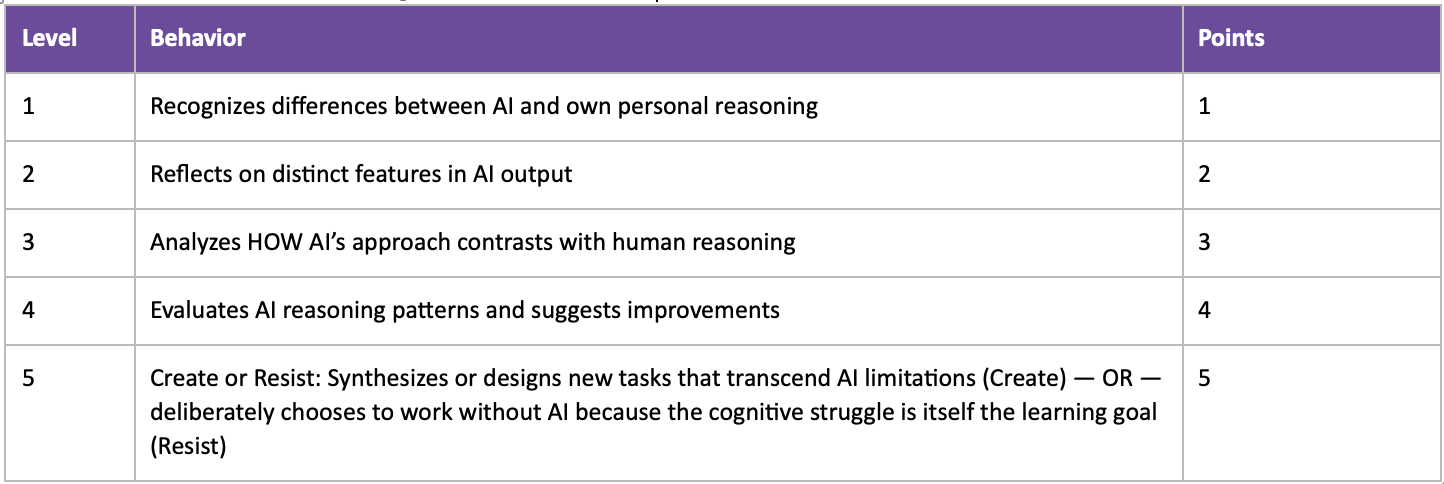
But this is not what reflection means within frameworks like UnBlooms. Here, reflection is metacognitive analysis — thinking about the quality and structure of your own thinking.
01- What strategy did I choose, and why? Students examine the decisions behind their approach, not just the outcome.
02- Where did my reasoning change? Identifying the inflection point in thinking reveals how understanding develops.
03- How does my reasoning differ from the AI’s? Comparison forces students to articulate what is distinctly human about their approach.
04- What would I do differently next time? This question bridges the current learning to future performance.
This kind of structured reflection is not introspection for its own sake. It is the mechanism by which students consolidate the effort they have invested — the cognitive equivalent of stepping back from the assembled bookshelf and understanding what you actually built and how.
We do not learn from experience alone. We learn from reflecting on experience. Reflection is what converts effort into understanding — and understanding into ownership.
— John Dewey
What I have learned is people value things more when they create them themselves, so if AI removes the effort from learning, students may lose both the learning and the psychological reward that comes from doing the work.
The Spiral, Not the Circle
One distinction worth holding onto: the difference between a circle and a spiral.
A circle brings you back to the same place. In learning terms, this looks like repetition without improving.. students revisit ideas but at the same level of sophistication each time. Experience, reflect, apply. Experience, reflect, apply. Nothing compounds.
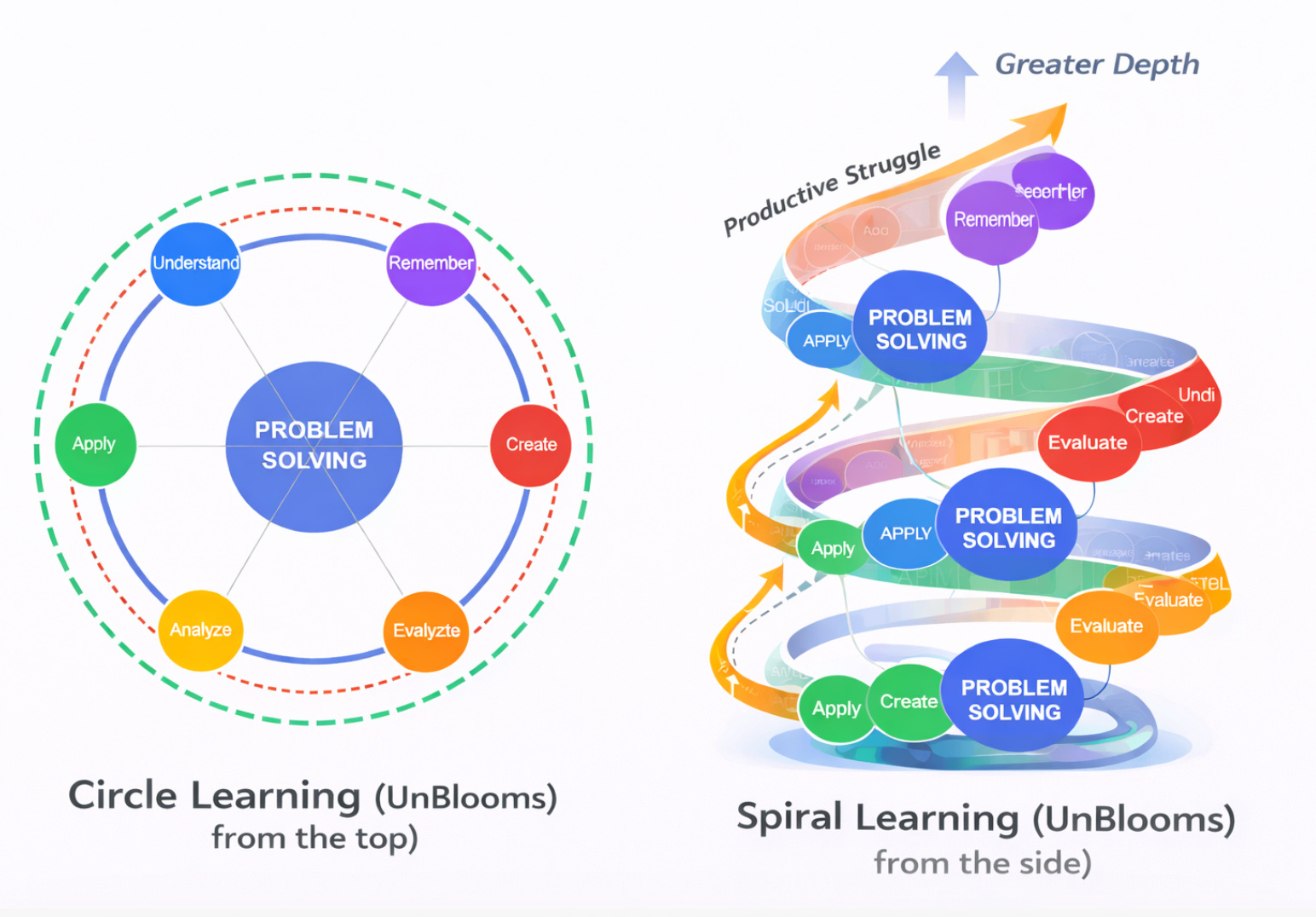
A spiral brings you around again, but higher. Each loop adds depth. Each return to the same concept carries more nuance, more critical distance, more integrated understanding. Jerome Bruner described this as the spiral curriculum, and it maps closely to what productive struggle and reflection actually produce over time.
Now in the age of AI we have the Discernment Spiral Learning (UnBlooms) which elevates each time students are questioning, generating, critiquing and refining. At each step students are questioning the output which keeps critical evaluation in the loop.
Unblooms is centered around what problem are you trying to solve.
A problem-centered learning design produces spiral learning. Students do not move through cognitive levels in a fixed sequence. They orbit the central problem, each pass adding layer and precision .. how productive struggle and reflection compound over time.
Using AI Without Losing the IKEA Effect
The question, then, is not whether to use AI in learning. It is how to use it so that students still build something ..and therefore still own something.
When designing assessments in the age of AI, sometimes the why matters more than the how, Is the student here because they're curious? Because they have a test tomorrow? Because they need to produce a deliverable?
Or, because they're genuinely stuck and want to understand? Those are different incentive contexts and they should produce different engagement patterns..
The key principle is sequencing: students think first, AI enters second.
The Human-First AI Learning Loop.
(I write more in the upcoming book)
The Assumptions We Are Making
Any learning framework carries hidden assumptions. It is worth naming them — because as a useful principle reminds us, if you don’t know your assumptions, they are probably leading you without your awareness.
The IKEA Effect applied to learning assumes:
→ That effort, not just exposure, creates meaningful learning.
→ That emotional ownership improves retention, transfer, and motivation.
→That students who struggle productively, then reflect, develop more durable understanding than those who receive polished answers.
→That AI, used well, can deepen thinking — but used carelessly, can hollow it out.
These assumptions are broadly supported by learning science. But they are assumptions nonetheless — worth examining as AI tools become more capable and the shortcuts they offer become more tempting.
The Design Question Every Educator Must Ask
Does this activity — with AI in it — still require students to build something? Or have I accidentally given them the furniture pre-assembled, and then wondered why they don’t care about the room?
The Human Thing That Stays
There is one more dimension worth mentioning.
The IKEA Effect is also about the emotional experience of creating something , the frustration, the small victories, the investment of self into a process. These emotional undercurrents are part of what makes learning human.
Curiosity is activated by problems that resist easy solutions. Empathy develops when students must consider perspectives that complicate their own. Satisfaction requires that something was actually difficult before it became clear.
None of these emotional experiences can be generated by receiving a pre-built answer. They require participation in the act of building. Which is why the most important question in AI-era learning design is not how do we use AI? but rather: how do we use AI without accidentally stripping the humanity from learning?
UnBlooms, at its core, is one answer to that question. Center the problem. Require the student to build. Let reflection transform effort into understanding. Let AI in — but only after the student has already started assembling.
The result may be a little wobbly. It may not be as polished as what the AI would have produced alone. But I am happy with it. You could say maybe its because I built it. And that, it turns out, is not a small thing.
“If AI builds everything, students learn to admire the furniture.
If students build something first, they learn how to live in the room.
AI doesn’t think.
The IKEA Effect is the right frame for this, and almost nobody is using it. Everyone else is still stuck on plagiarism. You went to the part underneath it, that a kid who never builds never gets to own the thing, and that losing the ownership is where the caring quietly dies.
The sequencing line is where our work meets. Think first, AI second. I teach the same rule and call it ownership before extension. We got to the same law through different doors.
Where I think we fork is the interesting part. You retire the staircase and put a loop in its place. I keep the staircase and rebuild the foundation underneath it, because I don't think Bloom was wrong, I think AI just made every rung skippable. Tear it down or root it deeper, same broken staircase, two honest answers to it. Good to be reading someone working this problem seriously.